The Life and Legend of Alexander McQueen

Early Years
McQueen was born on March 17, 1969, to humble beginnings, being 1 of 5 children supported by a cab driver father and teacher mother. As a teacher of sociology, it's safe to assume that McQueen and the inspiration for his culturally deductive looks.
Known as Lee to his friends for most of his life, McQueen discovered his homosexuality at an early age, and was teased extensively about it by his classmates growing up. For this reason, at 16 years old, McQueen dropped out of school. Soon after, he found work as a tailor on Saville Row, which is London’s Mayfair District, famous for offering made-to-order men’s suits.
Professional Beginnings
From tailoring, McQueen moved on to designing-first, trying his hand in the creation of theatrical costumes with designers, Angels and Bermans. Here, he had the opportunity to practice the dramatic styles that he would later become known for. After putting in some time here, McQueen left London, venturing to Milan, where he would work as a design assistant to Italian designer Romeo Gigli for a short time.
Upon his return to London, McQueen enrolled at Central Saint Martin’s College of Art and Design in 1992. There, he earned his Master's degree in fashion design, and his final project-which was a collection inspired by Jack the Ripper-was famously bought in its entirety by eccentric London stylist, Isabella Blow. The two would become long-time friends after this, and Blow would be instrumental in McQueen's career for the years to come.
It wasn't long after graduating that McQueen began his own line of women's clothes. He experienced early success in this, in part thanks to the introduction of several original designs, including “bumster” pants, which were named after their extremely low-cut waistline.
Only 4 years after his graduation and in response to the success of his original designs, McQueen was named Chief Designer of Louis Vuitton-owned Givenchy-a French haute couture fashion house still popular today. McQueen would later say that the job “constrain[ed] his creativity,” and, “The only way it would have worked would have been if they had allowed me to change the whole concept of the house,” Regardless of his discontent, McQueen won British Designer of the Year 3 out of his 5 years at Givenchy: 1996, 1997, and 2001.

Alexander McQueen: The Brand
While at Givenchy, McQueen was still dedicating some of his creative energy to his own brand, that he began years prior in 1992. In the year 2000, this proved to be a wise business decision for him, when Gucci-a brand known for investing in promising lesser-known design labels-bought a 51% stake in his private company, providing him the capital he needed to leave his job at Givenchy and expand. This was also the year that openly gay McQueen tied the knot, marrying George Forsyth, a documentary film-maker. To McQueen's disappointment, this marriage would only last 1 year, when Forsyth chose to leave him, predominantly for the reason of having tired of being a part of his struggles with addiction.
Thanks to this new influx of capital, McQueen's brand skyrocketed. Thanks to his new-found autonomy allowing him the liberty of full creative freedom, his fashion, unrestrained, earned him the recognition of another British Designer of the year award in 2003. This year, he also stacked on several other accomplishments, including the title of Dame Commander DBE (The Commander of the Most Excellent Order of the British Empire-a recognition for those doing outstanding public service, awarded by the Queen of England, herself), and, from the Council of Fashion Designers of America, an International Designer of the Year award. 2003 was also the year that McQueen opened up several new storefronts outside of London, in cities like New York, Milan, Las Vegas, and Los Angeles.
Known to be anything but the stereotypical designer image at the time, McQueen was unbothered by his lower-class background and lack of traditional good looks and personal style that most designers at the time flaunted. Even to his shows, McQueen was often dressed casually, even frumpy, clarifying for all that he was proud of where he came from, and playing a part in him breaking down the traditional mold of a successful designer.
The Shows
Watching an Alexander McQueen fashion show comes with a guarantee of one thing, never a dull moment! His styles were filled with little repetition and much innovation, despite the shows providing a consistent theme and cohesive feel throughout. These themes, often dealt with more controversial topics in sociology, and paved the way for designers that followed him to dig deeper.
His models-McQueen's girls-quickly became some of the most respected in the industry, as the theatrical aspects of his shows required more of them than most designers. Some of his most notable friendships throughout his life were with his models, including Kate Moss and Annabelle Neilson.

Here are just a few of McQueen's most highly regarded shows!
Spring/ Summer 2001: “VOSS”
VOSS was staged to look like a psychiatric ward floor, with a set composed entirely of mirrors. These mirrors we’re double-sided, so, when the models came out- intentionally, 2 hours late-the audience was able to see them, but the models could only see themselves. This tardiness can be interpreted as the first instance of a theatrical nature to this show. The mirrors left the audience with nothing to see but themselves, pictured in this psychiatric ward setting, encouraging a degree of self-reflection, as well as potentially making a broader statement about mental health facilities at large, and pushing a Mad hatter "We're all a little mad here," narrative.
The entire show was true to the theme, with models staying perfectly in character throughout. Some danced freely inside the box, representing a delusional or disassociated person in an asylum; some pressed their faces against the wall; one laughs hysterically at her own reflection, and one even tore the dress she was wearing apart-symbolically releasing her from its confines. Most wore head coverings to look like bandages, as well. McQueen, described these as representative of surgery-surgery to change the way you are. Voss, in my opinion, is some of McQueen's best work throughout his career. In it, he dances on the thin line between genius and crazy-a line that serves him well. Watch the entire show below.
Watch S/S 2001 “VOSS”:

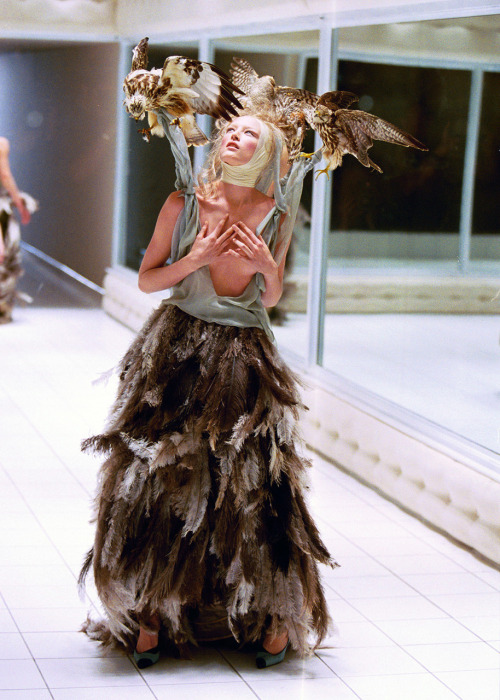
A dress inspired by the Alfred Hitchcock film “The Birds” (1963) McQueen used the influence of birds in many of the pieces of this collection and the name Voss came from a Norwegian town that is most widely known for its wildlife habitat-especially its birds.

McQueen draws a lot of his inspiration from other nature, well exemplified in this look-a dress of oyster shells paired with a neck piece of silver and Tahiti pearls, the model bit on during the show. The Japanese influence, prevalent in the use of a Japanese silk screen covering, is seen throughout this collection as well.
Spring/ Summer 2010: Plato’s Atlantis
Plato's Atlantis was McQueen’s final show, and-as expected-was revolutionary. The overarching theme was climate change, with a set composed of machines and technology and strongly inspired by nature, and prints-including patterns from insects and reptiles, also deriving from the natural world.
Overall, the show was constructed to feel science fiction. It began with a large projection, showcasing the models tied down with snakes crawling across them. The results of this scene, add to the dystopian future that McQueen warns us of with this show. If we cannot reverse the effects of climate change, we'll be forced to reckon with a world underwater, composed of people that can only survive as half-human and half-bionic.
Some unique aspects to note of this show are that the clothes were all created on the models-like in Haute Couture-to perfect their 3D characteristics. Even more excitingly, this was the first fashion show ever to be live-streamed. This is commonplace now-thankfully, as it's been monumental in breaking down the barrier of exclusivity outside the elite in the world of fashion, but was revolutionary at the time. It was an exciting element to include in McQueen's last show and served as a wonderful backdrop for Lady Gaga to debut her song, "Bad Romance."
Watch S/S 2010 “Plato’s Atlantis”:

This is McQueen's metamorphosis dress. To him, metamorphosis had similar qualities to plastic surgery-which he vehemently opposed. He uses this hybrid dress to symbolize transforming mentally rather than physically.

AKA The Jellyfish Dress, this all-studded bubble mini dress changed colors according to the light, thanks to iridescent palettes. It, along with many others, can be seen today in the Metropolitan Museum of Art exhibit, "Savage Beauty."
Spring/Summer 1999: No. 13
No. 13 as a show, was a statement regarding advancements in technology taking away our jobs. This was a real fear for many at this time, and-especially considering recent advancements in AI technology-is still at the forefront of many people's minds today.
The fashions included, showcase McQueen's take on women's professional wear, incorporating innovative cuts and modern fabrics, to classic professional pieces like suits and trousers in a neutral color pallet. This line was meant to celebrate women's growing presence in business and work and is a feminist favorite. The real showstopper is the last piece included. With the use of electric arm on stage, we can see the last look being finalized, to provide us with an example of machine's ability to take human jobs.
Watch S/S 1999: “No. 13”:

This sheer dress, with a box shaped motif headdress, is one of the most glamorous pieces of this collection. The headdress serves to represent the working world functioning to keep us in a box.

This is the final piece in its first stage. Before the machine was utilized, it was eggshell white and embodied a soft tulle underneath. The belt top exemplifies an element of bondage that is often seen in McQueen's designs.

His Untimely Demise
As many creative geniuses do, McQueen struggled throughout his life openly and immensely with addiction. His, he self-proclaimed as the embodiment of sex, drugs, and rock and roll-3 things he loved. Cocaine was his drug of choice, and he used it consistently for much of his life, claiming that it helped with the back issues he developed from sewing over time, the pressure to meet deadlines he faced while maintaining-at times, multiple-lines, and helped him to stay at a healthy weight, as he struggled with body image issues as well. Unfortunately, it would also be his downfall.
After the Gucci Group bought a stake in his company, McQueen's work became so negatively affected by his drug abuse, his new bosses and coworkers staged his first intervention, where he admitted that the drugs made his designs “more erratic" and agreed to attend rehab. He left after his first day there, though, claiming that the facility was poorly run. It became such a problem that his team had to ask each venue that hosted his shows to have a private room designated for him to use.
This ongoing struggle with addiction along with his many difficulties in his love-life, including having contracted an STD from his husband years prior, led to the beginning of McQueen's suicidal ideation. In 2007, these progressed even further when long-time friend, Isabella Blow, committed suicide herself. McQueen dedicated his 2008 Spring/ Summer line to Blow, it struck him so emotionally.
Two years later, McQueen’s mother lost her battle to cancer. He dealt with this mostly privately for years, but it, too, caused him intense emotional turmoil. This was the last straw for Alexander McQueen. The day before his mother’s funeral, on February 11th of 2010, Alexander McQueen was found dead in his Mayfair, London apartment. He was only 40 years old and the cause of death was suicide. His last line was officially Plato’s Atlantis, but before committing, he was able to contribute about 80% of his next line, called Angels and Devils. The theme and name of his next show was cruel foreshadowing for his untimely departure.
The Legacy
McQueen’s rise from high school dropout to internationally famous designer is a remarkable story. His fascinating shows and bold styles impressed the world and have made a lasting impact in fashion. His namesake brand is still operating today and continues to wow the industry as longtime co-designer Sarah Burton took over in the face of his passing.
McQueen’s fashions are honored today by a 2011 exhibition of his creations at the Metropolitan Museum of Art in New York City. His life is also memorialized as subject of 2018 documentary McQueen by Ian Bonhôte and Peter Ettedgui. Along with interviews of his family, friends, and associates, the documentary includes little-seen footage of McQueen himself in interviews.
Comments
Post a Comment